Scene perception
UnrealCV Dev for UnrealZoo provides structured scene state for agents. It is separate from the open-source command reference.
Occupancy
All occupancy arrays are boolean NumPy data with axis order x,y_up,z.
Coordinates are meters; origin_cm and yaw_degrees place the grid in UE.
Profiles
The profiles support the LINGO occupancy-grid convention used by the LINGO project: boolean grids describe scene occupancy in a fixed local frame, with a choice between fast component-bounds rasterization and mesh-surface rasterization. See the LINGO release repository. The profile names are compatibility presets, not different data types.
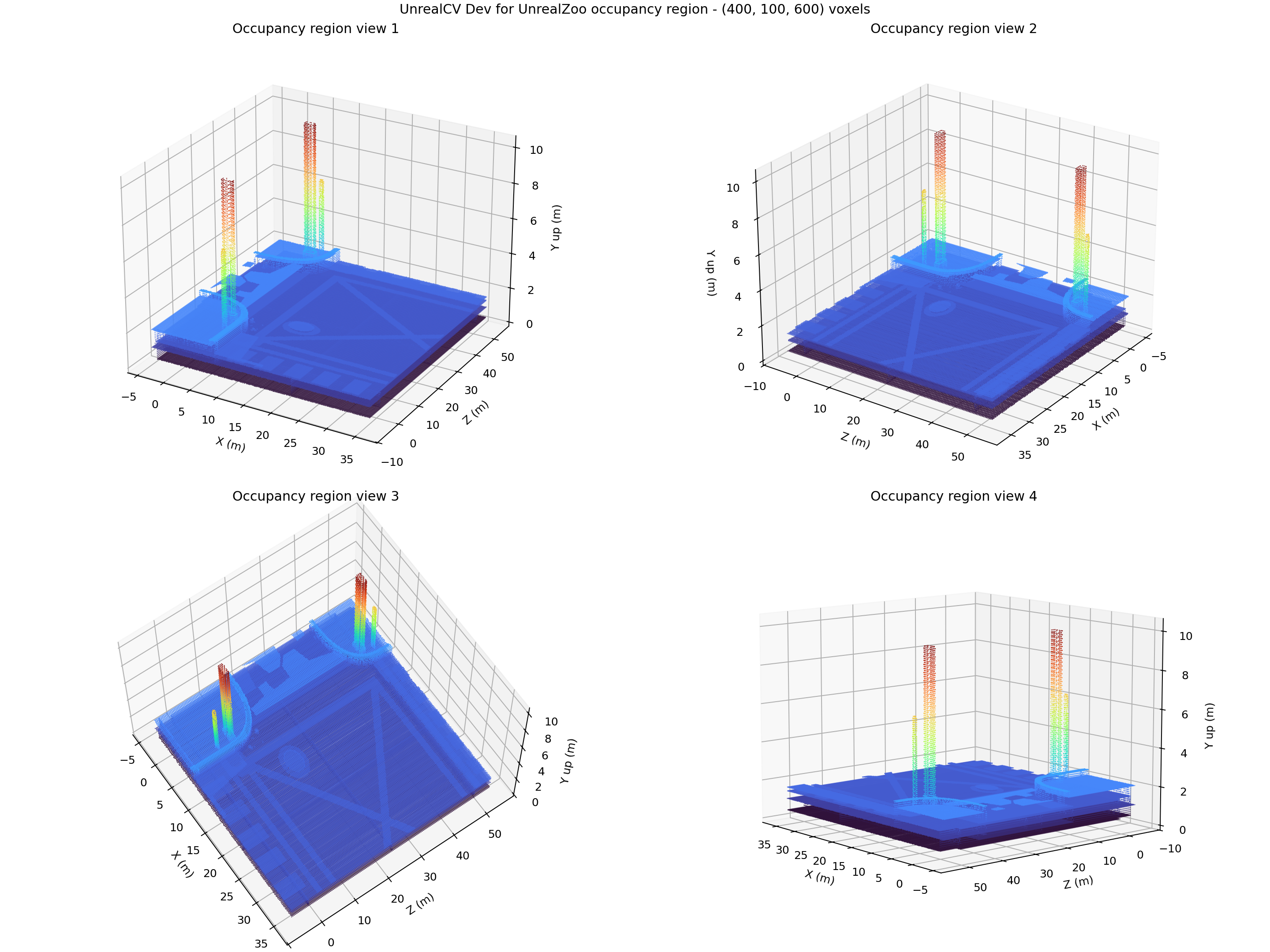
lingo_vis is 8 x 2 x 12 m at 10 cm (shape 400 x 100 x 600).
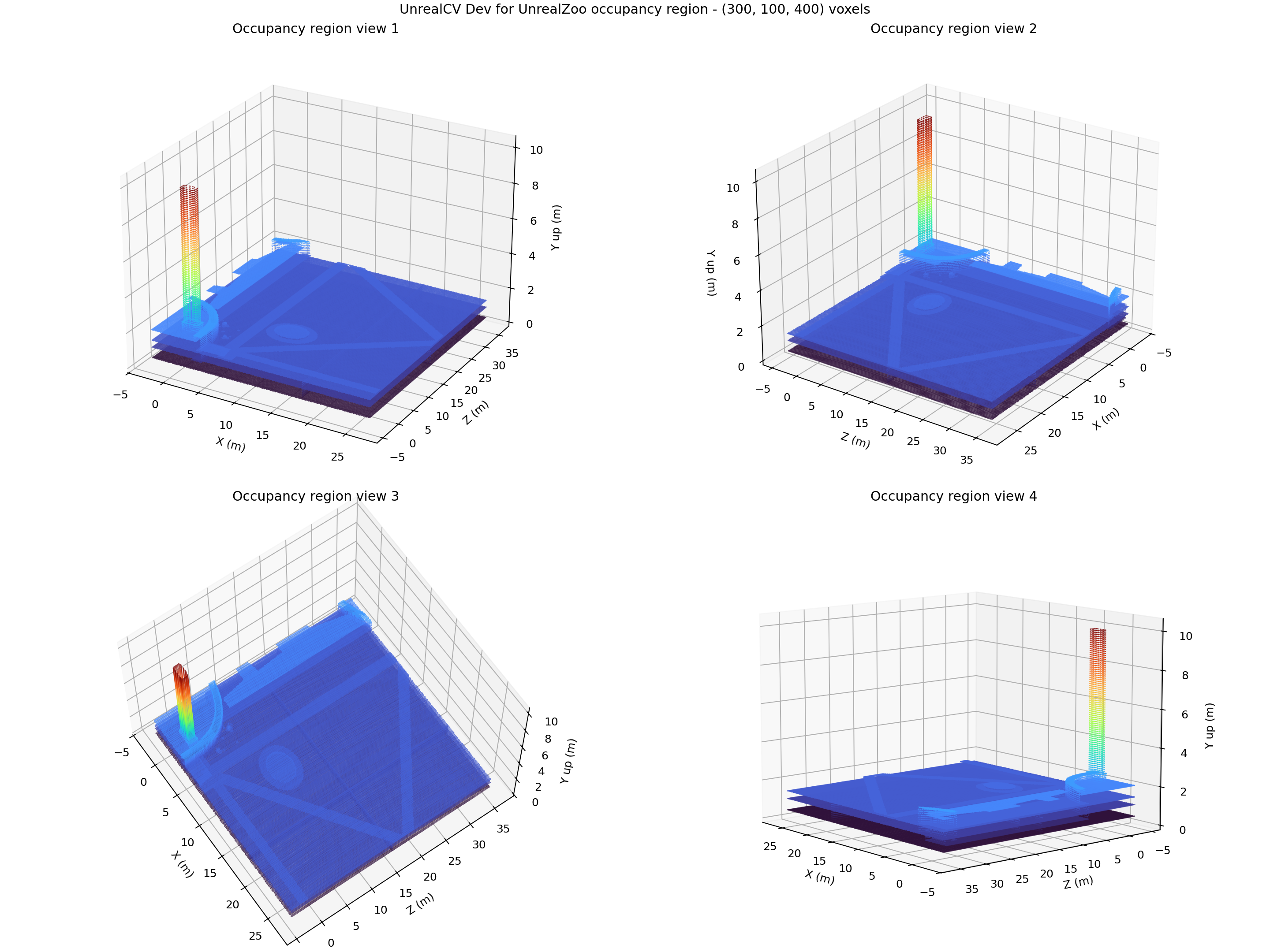
lingo_train is 6 x 2 x 8 m at 10 cm (shape 300 x 100 x 400).
Commands:
vget /scene/occupancy npy lingo_vis mesh
vget /scene/occupancy/spec lingo_vis mesh
vget /scene/occupancy_shared lingo_vis mesh
Use bounds for fast AABB occupancy and mesh for triangle-based surface
occupancy.
NPY output
vget /scene/occupancy npy lingo_vis mesh returns a NumPy bool array.
For example:
grid = np.load("lingo_vis.npy", allow_pickle=False)
print(grid.shape, grid.dtype)
# (400, 100, 600) bool
The dimensions are (x, y_up, z):
axis 0: 400 voxels across
-4 .. 4 m(10 cm per voxel);axis 1: 100 voxels across
0 .. 2 mheight;axis 2: 600 voxels across
-6 .. 6 m.
The value grid[x, y_up, z] is True when that voxel is occupied. The
lingo_train profile is (300, 100, 400) with bounds 6 x 2 x 8 m.
The exact bounds and shape can be queried with /scene/occupancy/spec.
Custom region
Use explicit bounds instead of a profile. Order is
min_x max_x min_y max_y min_z max_z voxel_size_m.
vget /scene/occupancy_region npy mesh -150 150 -150 150 -150 150 1
vget /scene/occupancy_region/spec mesh -150 150 -150 150 -150 150 1
vget /scene/occupancy_shared_region mesh -150 150 -150 150 -150 150 1
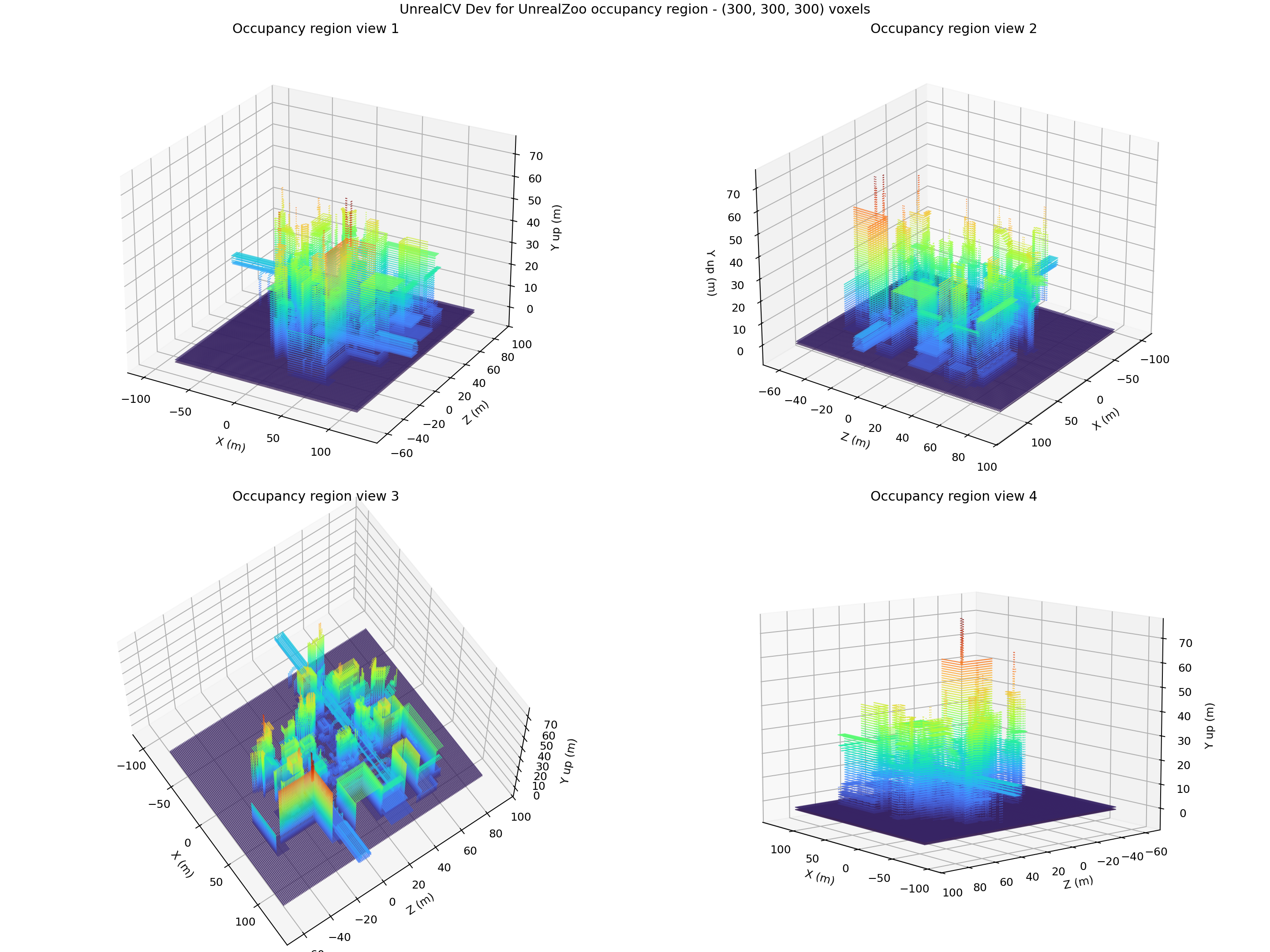
This example covers 300 m in every axis at 1 m resolution.
Python client:
grid = client.get_scene_occupancy_region(
    (-150, -150, -150), (150, 150, 150),
    voxel_size_m=1.0, method="mesh")
spec = client.get_scene_occupancy_region_spec(
    (-150, -150, -150), (150, 150, 150), voxel_size_m=1.0)
The shape is ceil((max_m - min_m) / voxel_size_m). Choose voxel size to
keep the grid within the runtime voxel budget.
Native perception
vget /scene/perception returns compact JSON for agent use:
vget /scene/perception
vget /scene/perception 1000 16 8
The response includes agent pose, nearby object transforms and bounds, tags, materials, line of sight, blockers, navigation reachability, radial rays, and occupancy capability metadata. It does not embed the voxel grid.
Real output
Captured from the Tokyo map with vget /scene/perception 1000 4 4:
{
  "schema_version": "unrealcv.native_perception.v1",
  "world_name": "Tokyo",
  "search_radius_cm": 1000,
  "max_objects": 4,
  "agent": {
    "position_cm": {"x": -5160.63, "y": -1029.99, "z": 138.64},
    "rotation": {"pitch": 0.0, "yaw": -1.002, "roll": 0.0}
  },
  "agent_nav": {
    "available": true,
    "reachable": false,
    "reason": "target_not_on_navmesh"
  },
  "objects_found": 138,
  "objects_returned": 4,
  "objects_truncated": true,
  "objects": [{
    "name": "StaticMeshActor_3002",
    "distance_cm": 114.72,
    "line_of_sight": true,
    "relative_to_agent_cm": {"x": -102.61, "y": 4.63, "z": 51.11}
  }],
  "rays": [{
    "yaw_degrees": 90.0,
    "hit": true,
    "actor": "StaticMeshActor_1349",
    "distance_cm": 193.86
  }],
  "ray_channel": "Visibility",
  "units": "world vectors and distances are centimeters; angles are degrees"
}
Here objects_found is the number of actors inside the search radius;
objects_returned is capped by max_objects. line_of_sight is the
visibility result from the agent camera. A blocked_by field is added when
another actor occludes the target. Rays provide radial visibility checks, while
agent_nav reports navigation projection and reachability. This structured
snapshot is intended to give an agent useful scene state without image
recognition.